

Want your marketing dollars to work harder? A good marketing budget fuels business growth. It’s more than just number crunching.
This guide will help you build a budget that fits your goals. We’ll explore how to get the most from your investment.
Marketing budgets usually range from 6.5% to 12% of yearly revenue. These changes are based on company size and industry.
Many businesses spend too much or too little in key areas. Let’s make sure you’re not one of them.
Key Takeaways
- Marketing budgets vary by industry and company size
- Digital marketing offers higher conversion rates than traditional methods
- Email marketing boasts an impressive 4,400% average ROI
- B2B companies allocate about 10% of revenue to marketing
- Effective budgeting can increase campaign success by 63%
- Customer retention strategies yield significant returns
- Regular competitor analysis improves budget effectiveness
Understanding Marketing Budget Fundamentals
Creating an effective marketing budget is crucial for business success. It’s about strategic thinking and aligning spending with goals.
Definition and Importance of Marketing Budgets
A marketing budget outlines the expected costs for promoting your business. It helps manage resources, track performance, and make data-driven decisions.
Key Components of a Marketing Budget
When making your budget, think about these items:
- Digital advertising costs
- Content creation expenses
- Social media management tools
- Email marketing software
- Website maintenance and updates
Break down your budget by tool and timeframe to avoid overspending. Identify fixed and variable costs for better planning.
Impact on Business Growth
A good marketing budget can help your business grow. Many businesses have increased their marketing budgets lately.
Focus on brand awareness and set clear goals. Measure success through sales volume and website visits.
“Effective marketing budgets require careful outlining and should be informed by strategy.”
Your marketing budget plan will change as your business grows. Stay flexible and use data to guide your strategy.
Setting Clear Marketing Goals and Objectives
Clear goals are vital for setting a marketing budget. Businesses with defined objectives generate 12 times more ROI than those without.
SMART goals are key for marketing budget optimization. These are Specific, Measurable, Achievable, Relevant, and Time-bound objectives.
For instance, I might aim to lower the website bounce rate. Or I could seek more quality comments on social media posts.
| Benefit | Impact |
|---|---|
| Improved Performance | 63% improvement when aligned with business strategy |
| Better Positioning for Growth | 88% of companies with data-driven alignment |
| Increased Team Productivity | 20% boost with SMART goals |
| Enhanced Lead Conversion | 25% improvement with measurable objectives |
Clear goals make every dollar in the marketing budget work harder. It’s about investing wisely for maximum impact.
How to Create an Effective Marketing Budget

A solid marketing budget is key to business success. Let’s explore how to allocate resources for digital and social media marketing.
Evaluating Current Marketing Efforts
Check your existing marketing initiatives first. Look at website traffic, social media engagement, and conversion rates.
Analyzing Past Performance
Study data from previous marketing campaigns. Track ROI, customer acquisition cost, and lifetime value.
This reveals trends to guide your budget allocation.
- Conversion rates
- Website traffic data
- Lead generation statistics
Identifying Priority Marketing Channels
Choose marketing channels that match your goals. B2C product companies should spend about 14.2% of revenue on marketing.
Focus on top-performing digital platforms. Adjust your spending as needed.
Review and update your budget often. This ensures it supports your marketing goals and drives growth.
Industry Benchmarking and Budget Allocation
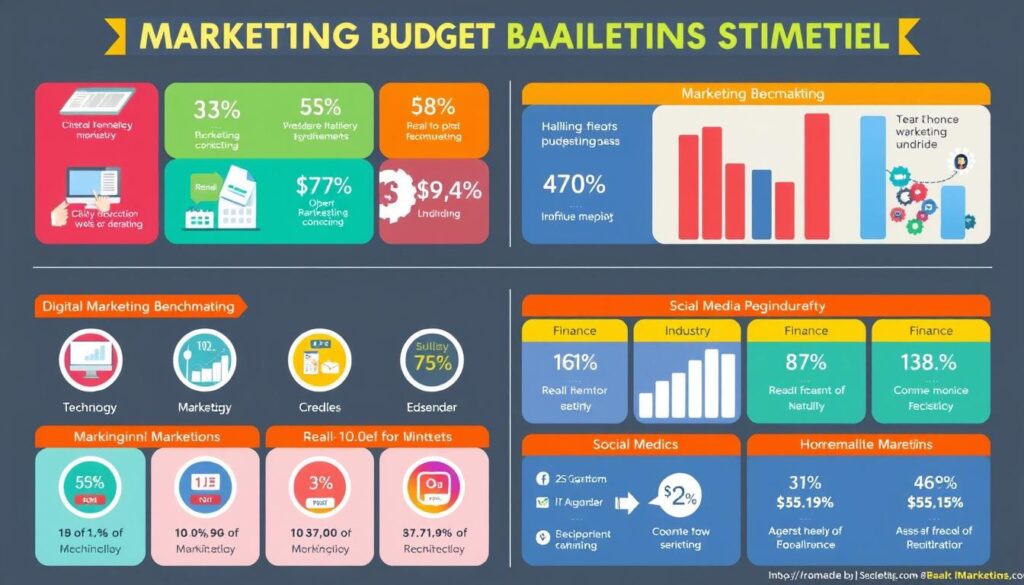
Marketing budget benchmarking is vital for planning. Here are key insights on how industries allocate their marketing spend.
B2B vs B2C Marketing Spend Differences
B2B and B2C companies have different budget allocations. B2B product companies spend about 9.4% of their revenue on marketing.
B2C companies, like Consumer Packaged Goods, allocate around 18.09%.
Industry-Specific Budget Percentages
Let’s explore how various industries allocate their marketing budgets:
| Industry | Marketing Budget (% of Revenue) |
|---|---|
| Consumer Packaged Goods | 18.09% |
| Education | 14.59% |
| Communications/Media | 13.82% |
| Transportation | 11.67% |
| Banking, Finance, Insurance | 11.18% |
Competitive Analysis Insights
In 2023, 75% of CMOs reported ‘doing more with less’. The 70/20/10 rule is a popular strategy.
It suggests 70% for proven tactics, 20% for innovation, and 10% for experiments. This helps balance old and new methods in digital marketing.
Determining Your Marketing Budget Size

Setting a marketing budget can be tricky. Here are some insights to help you succeed.
Most small businesses spend 7-12% of their revenue on marketing. This works well if your business margins are above 10-12%.
New businesses might use a fixed budget based on available capital. Companies often allocate 5-10% of their total revenue towards marketing.
Consider your industry and size when deciding your budget.
Let’s look at some marketing budget strategies:
- Percentage of revenue method
- Fixed budget based on available capital
- Goal-driven budgeting
Here’s a breakdown of typical budget allocation across different marketing channels:
| Marketing Channel | Percentage of Budget |
|---|---|
| Paid Advertising | 25-40% |
| Social Media Marketing | 15% |
| Content Marketing | 20-30% |
| SEO | 10-20% |
| Other Channels | 5-20% |
These percentages can change based on your business needs. Track your return on investment (ROI) for each channel.
Use marketing attribution to find ROI for specific channels. This helps you allocate your budget more precisely.
Digital Marketing Channel Distribution

Smart budget planning is key for great marketing results. Let’s explore how to split your money across different digital channels.
Social Media Marketing Allocation
Social media is a big deal in today’s marketing world. Use 20-30% of your money for social media tasks.
This covers making posts, paying for ads, and working with influencers.
Content Marketing Investment
Content marketing helps bring in more visitors to your site. Spend 25-35% on making great stuff like blogs, videos, and pictures.
This helps your business grow over time and keeps customers coming back.
PPC and Paid Advertising Budgeting
PPC and other paid ads can get quick results. Use 30-40% of your budget for these to get seen fast.
| Channel | Percentage of Budget | Primary Goal |
|---|---|---|
| Social Media | 20-30% | Brand Awareness |
| Content Marketing | 25-35% | Organic Growth |
| PPC/Paid Advertising | 30-40% | Lead Generation |
This plan helps you grow now and in the future. Keep checking how things work and make changes when needed.
Budget Allocation Strategies
Smart marketing budget strategies can make or break a company’s success. Effective budget planning balances proven methods with innovative approaches.
The 70-20-10 rule is a powerful strategy. It divides your budget into three parts.
Allocate 70% to channels you know work well. Use 20% for emerging opportunities. Save 10% for experimental tactics.
| Allocation | Percentage | Focus Area |
|---|---|---|
| Proven Channels | 70% | SEO, Google Ads, Email Marketing |
| Emerging Opportunities | 20% | Influencer Marketing, Podcast Advertising |
| Experimental Tactics | 10% | AR/VR Campaigns, New Social Platforms |
Businesses often see great results with 6.5% to 8.5% of revenue for marketing. Startups might need to invest more to build brand awareness.
Flexibility is key in budget planning. Keep an eye on performance metrics. Be ready to shift resources as needed.
Tracking ROI and Performance Metrics
Tracking ROI and performance metrics is key for marketing budget optimization. Let’s explore the main parts of this process.
Key Performance Indicators (KPIs)
Picking the right KPIs is vital for measuring marketing success. I look at website traffic growth, conversion rates, and customer engagement.
These indicators help me assess our campaigns’ success. They also guide future budget choices.
Analytics Tools and Tracking Methods
Google Analytics is my top choice for tracking website performance. It gives insights into traffic sources, user behavior, and conversions.
For social media, I use platform-specific analytics. These tools help me make data-driven budget decisions.
Budget Adjustment Protocols
I often review our marketing performance and adjust our budget. If social media does better, I’ll give it more resources.
This flexible approach ensures we invest in high-ROI strategies. It’s an ongoing process that needs constant attention.
These tracking and adjustment methods have greatly improved our marketing budget. The results are worth the effort.
Common Marketing Budget Mistakes to Avoid
An effective marketing budget is crucial for business success. Many companies stumble when allocating their resources.
Let’s explore some common pitfalls and how to avoid them.
Underinvestment in Successful Channels
Companies may overlook up to 80% of their budget on inconsistent strategies. It’s vital to identify your top-performing channels and invest wisely.
Ignoring Customer Retention Marketing
Many businesses focus solely on acquiring new customers. This is costly, as it’s five times more expensive than keeping existing ones.
A 5% increase in customer retention could boost profits by 25% to 95%.
Poor Data Analysis
Only 21% of businesses successfully track their marketing ROI. Without proper analysis, you risk wasting half your budget on ineffective campaigns.
| Mistake | Impact | Solution |
|---|---|---|
| Underinvestment in successful channels | 80% budget misallocation | Regular performance reviews |
| Ignoring customer retention | 5x higher acquisition costs | Balance acquisition and retention efforts |
| Poor data analysis | 50% budget waste | Implement robust tracking systems |
Avoid these mistakes to create an effective marketing budget. Successful budgeting requires constant evaluation and adjustment.
Marketing Budget Templates and Tools
Making a marketing budget plan is key to success. The right tools can make this task easier.
Small businesses can use a simple spreadsheet. It should list marketing channels, planned costs, and actual spending.
Better tools exist for bigger marketing budgets. Many platforms offer built-in budgeting features based on past data.
- Spreadsheet templates for basic budget planning
- Marketing automation platforms with budgeting features
- Analytics tools for performance tracking
- Project management software for budget allocation
Linking these tools with analytics gives real-time budget insights. This helps you move money to channels that work best quickly.
These tools aim to make budgeting easier and spending smarter. Use the right mix to create a budget that gets results.
Conclusion
A well-planned budget is crucial for business growth. Tracking performance is key, as many marketers struggle to measure ROI effectively.
Consider the 70-20-10 rule when crafting your marketing budget strategies. This approach balances reliability with innovation in your marketing efforts.
Businesses allocating 10-15% of revenue to marketing often see higher growth. Digital marketing and social media deserve attention in your budget.
SEO shows an ROI of 122%, while email marketing reaches 440%. These channels can drive significant results for your business.
Regularly review your budget and adjust based on data-driven insights. This will help you navigate the changing marketing landscape successfully.
FAQ
How much should I allocate to digital marketing in my overall marketing budget?
Many businesses today allocate 50-70% of their total marketing budget to digital channels. Start with a 60/40 split between digital and traditional marketing.
Adjust based on performance metrics and ROI. Your industry, target audience, and business goals will influence this decision.
What’s the ideal marketing budget as a percentage of revenue?
A common rule is to allocate 7-10% of your revenue to marketing. This can vary based on your industry, company size, and growth stage.
Startups or companies in competitive industries might spend up to 20% on marketing. This helps them gain market share.
How often should I review and adjust my marketing budget?
Review your marketing budget quarterly at a minimum. This allows for timely adjustments based on performance data.
Be ready to make more frequent changes if your KPIs shift. New opportunities may also require quick budget adjustments.
What are some key performance indicators (KPIs) I should track for my marketing budget?
Essential KPIs include ROI, Customer Acquisition Cost (CAC), and Customer Lifetime Value (CLV). Conversion rates and engagement metrics are also important to track.
For digital marketing, monitor click-through rates and cost per click. Social media engagement rates can provide valuable insights too.
How can I optimize my marketing budget for better ROI?
Focus on data-driven decisions to optimize your marketing budget. Analyze the performance of your channels and campaigns regularly.
Allocate more resources to top-performing areas. Try new tactics, but measure their performance against established KPIs.
Should I invest more in customer acquisition or retention marketing?
It’s usually more cost-effective to retain existing customers than acquire new ones. Start by allocating 60-70% to acquisition and 30-40% to retention.
Monitor your customer acquisition cost (CAC) and customer lifetime value (CLV). This helps ensure you’re striking the right balance.
What’s the 70-20-10 rule in marketing budget allocation?
The 70-20-10 rule allocates 70% to proven channels, 20% to promising ones, and 10% to experimental tactics. This approach maintains a strong foundation while exploring new opportunities.
It allows you to stay innovative in your marketing efforts. You can adapt to changes while keeping your core strategies intact.






0 Comments