

Ever wondered if your digital marketing efforts are truly paying off? Measuring ROI is crucial in today’s fast-paced online world.
As a marketer, I’ve learned that understanding ROI is key. It helps make smart decisions and maximize your marketing budget.
The digital marketing ROI calculation isn’t just about crunching numbers. It’s about gaining insights into what works across various channels.
We’ll explore effective methods, tools, and metrics for gauging online strategies. You’ll learn to evaluate your digital marketing performance and make data-driven decisions.
Key Takeaways
- ROI measurement is essential for optimizing digital marketing strategies
- The basic ROI formula: (Increase in Revenue – Cost of Marketing) / Cost of Marketing
- A minimum ROI of 5:1 is often considered profitable in marketing
- Understanding the conversion funnel enhances targeting and ROI measurement
- Google Analytics 4 is a powerful tool for tracking digital marketing performance
- Integrating various tools can provide comprehensive insights into campaign effectiveness
Understanding Digital Marketing ROI Fundamentals
Digital marketing ROI tracks online campaign success. It helps calculate campaign ROI and make smart decisions.
Defining ROI in a Digital Marketing Context
ROI measures earnings compared to marketing spending. It’s a key metric for tracking online marketing success.
A $1,000 investment bringing $5,000 is a 400% ROI. That’s an excellent return!
Why ROI Measurement Matters
ROI shows if campaigns are worth the money. It helps understand what works and what doesn’t.
A good marketing ROI is at least 5:1. That means earning five dollars for every dollar spent.
Key Components of Digital Marketing ROI
When tracking ROI, we look at several factors:
- Cost Per Lead (CPL)
- Cost Per Acquisition (CPA)
- Click-through Rate (CTR)
- Customer Lifetime Value (CLV)
These metrics show our campaign’s full performance. A high CTR often means a higher ROI.
By focusing on these, we can improve our strategies. This helps boost our overall ROI.
The Basic ROI Calculation Formula
Let’s explore the basic ROI formula for digital marketing. This tool helps measure returns on digital campaign investments.
Here’s the simple ROI formula:
ROI = (Increase in Revenue – Cost of Marketing) / Cost of Marketing
This formula shows if our marketing efforts are working. We need to track costs and revenue increases carefully.
| Metric | Value |
|---|---|
| Campaign Cost | $1,500 |
| New Customers | 5 |
| Average Sales per Customer | 4 |
| Average Dollar Sale | $1,200 |
| Gross Profit Percentage | 30% |
Let’s use these numbers to figure out our ROI:
- Total Revenue: 5 customers × 4 sales × $1,200 = $24,000
- Gross Profit: $24,000 × 30% = $7,200
- ROI: ($7,200 – $1,500) / $1,500 = 380%
A 380% ROI is great! It’s higher than the 300% goal for new campaigns.
Using this formula helps us make smart choices. We can improve our campaigns and make more money.
Essential Metrics for Tracking Digital Marketing Performance
ROI analysis for digital marketing needs a focus on key metrics. Let’s explore the numbers that show online marketing success.
Conversion Rates and Sales Metrics
Conversion rates are vital for evaluating online marketing ROI. I use this formula: (conversions/clicks) x 100.
For example, 50 purchases from 2,000 visitors equals a 2.5% conversion rate. Average Order Value (AOV) also helps understand campaign performance.
Traffic and Engagement Metrics
Traffic metrics show digital marketing reach. I track unique monthly visitors with Google Analytics.
For engagement, I check the Click-Through Rate (CTR). A 5% CTR means 250 clicks from 5,000 views.
Cost per Acquisition (CPA)
CPA reveals spending for each new customer. The formula is: marketing costs/sales generated.
A $2,000 campaign gaining 100 new customers has a $20 CPA.
Customer Lifetime Value (CLV)
CLV is key for long-term digital marketing ROI analysis. It’s calculated as: (yearly customer revenue x customer years) – acquisition cost.
A customer spending $50 five times yearly for 3 years has a $750 CLV.
| Metric | Formula | Example |
|---|---|---|
| Conversion Rate | (clicks/views) x 100 | 2.5% (50 purchases / 2,000 visitors) |
| Click-Through Rate | marketing costs/sales generated | 5% (250 clicks / 5,000 views) |
| Cost per Acquisition | marketing costs / sales generated | $20 ($2,000 / 100 customers) |
| Customer Lifetime Value | (annual revenue x years) – acquisition cost | $750 (($50 x 5 x 3) – acquisition cost) |
These metrics help measure digital marketing campaign success. They guide data-driven decisions to boost ROI.
How to measure ROI in digital marketing campaigns

Measuring ROI in digital marketing is key for smart decisions. It helps grow your marketing budget effectively.
Set clear, measurable goals for your campaigns. Choose the right metrics to track your progress.
Use tools like Google Analytics for proper tracking. This gathers data from various digital channels.
Here’s a quick breakdown of key ROI metrics:
| Metric | Description | Importance |
|---|---|---|
| Marketing ROI | Profit earned from every dollar spent on marketing | Indicates overall campaign effectiveness |
| Conversion Rate | Percentage of visitors who take desired action | Measures campaign’s ability to drive actions |
| Customer Acquisition Cost | Cost to acquire a new customer | Helps optimize marketing spend |
ROI measurement helps understand your audience better. It improves your overall marketing strategy.
A good marketing ROI is typically 5:1. This means earning $5 for every $1 spent.
Analyze your data regularly to improve digital marketing ROI. Keep measuring and see your results grow!
Tools and Technologies for ROI Tracking
Great tools help with digital marketing ROI calculation. They make tracking ROI in online marketing easier and more accurate.
Google Analytics 4 Implementation
Google Analytics 4 is free and packed with features. It measures campaign effectiveness and sets up key events.
You can assign monetary values to goals. This gives a tangible way to measure success.
CRM Systems Integration
CRM integration with marketing tools shows the full customer journey. Tools like Ruler, starting at £199 monthly, identify lead sources.
They track revenue conversions. This integration is key for accurate ROI calculation.
Social Media Analytics Platforms
BuzzSumo is great for social media ROI. Plans range from $99 to $499+ monthly.
It tracks brand mentions, hashtags, and content engagement. This data helps calculate ROI from social campaigns.
The right mix of tools depends on your needs. Combining these tools gives a comprehensive view of ROI.
Understanding the Conversion Funnel
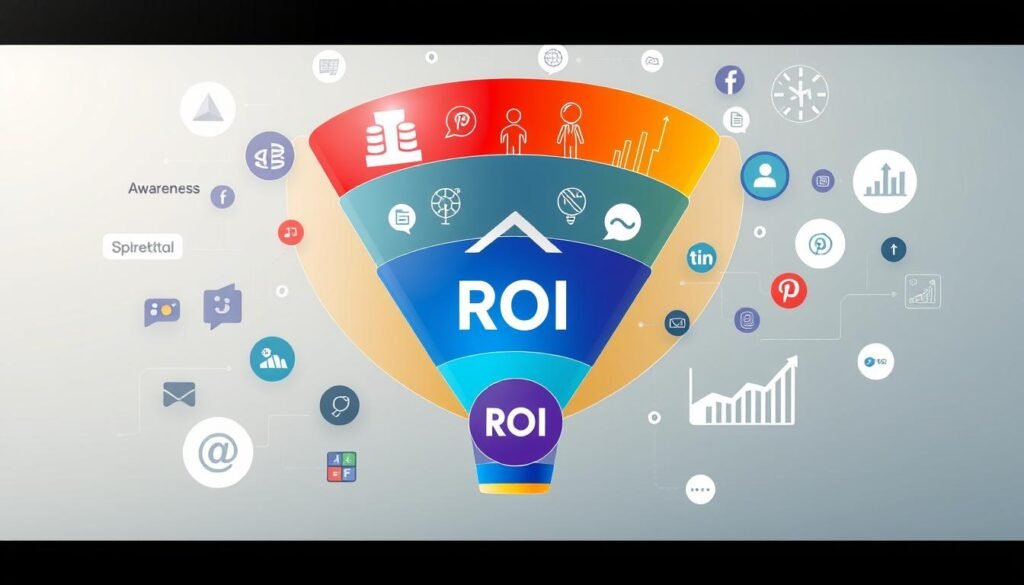
The conversion funnel shows how customers move from discovery to purchase. It has three key stages we’ll explore next.
High Funnel Activities
At the top, we aim to grab attention and build awareness. Content marketing and social media help attract traffic.
We track reach, impressions, and brand recall to measure success here.
Mid Funnel Engagement
In the middle, users know our product but need more info. We give helpful content to aid decisions.
Key metrics include engagement rates, time on site, and lead generation stats.
Low Funnel Conversion
At the bottom, leads become customers. We use personalized offers to encourage sales.
We focus on conversion rates, cost per acquisition, and revenue generated.
| Funnel Stage | Key Metrics | ROI Consideration |
|---|---|---|
| High Funnel | Reach, Impressions | Brand Awareness Impact |
| Mid Funnel | Engagement Rate, Lead Generation | Lead Quality and Potential Value |
| Low Funnel | Conversion Rate, Revenue | Direct Sales Impact |
By studying each funnel stage, we can boost our marketing and ROI. We track user actions to find weak spots.
Good ROI measurement looks at the whole funnel, not just sales. Every stage helps our digital marketing succeed.
Setting Realistic ROI Benchmarks
Setting realistic ROI benchmarks is vital for digital marketing success. A good start is the 5:1 industry average: $5 revenue for $1 spent.
Your business model and goals shape your specific benchmarks. Email marketing often sees 42:1 ROI, while Google Ads average 2:1.
- Average ROI: 5:1
- Exceptional ROI: 10:1 or higher
- Google Ads ROI: 2:1
- Email Marketing ROI: 42:1
Start by looking at your past data to set benchmarks. If you’re new, begin with modest goals and adjust later.
A positive ROI shows profit, but always aim higher. Keep improving your strategies.
“ROI is not just about numbers; it’s about understanding the value your digital marketing efforts bring to your business.”
Track these metrics often. Adjust your plans as needed to boost your digital marketing ROI.
Common Challenges in Measuring Digital Marketing ROI

Measuring online marketing success can be tricky. Let’s explore the main challenges and solutions.
Attribution Issues
Pinpointing which channel led to a sale is tough. Over 50% of businesses struggle with this problem.
Data Accuracy Problems
Accurate data is key for ROI calculations. Many businesses face tracking errors and inconsistent practices.
50% of small businesses have inconsistent tracking. This can lead to losing crucial data.
Using tools like Google Analytics can boost ROI understanding. It can improve it by up to 40%.
Time Lag Considerations
Digital campaigns often take time to show results. This lag can affect short-term ROI measurements.
Some campaigns may need months or years to show full impact. Set realistic timelines when checking ROI.
Tackling these issues can improve our ROI measurement accuracy. This leads to better marketing choices.
Advanced ROI Measurement Strategies
I’ve found powerful ways to measure ROI in digital marketing campaigns. These methods go beyond basic math and dig deep into campaign results.
Multi-touch attribution models track customer interactions across various touchpoints. They provide insights into the customer’s path to purchase.
Implementing these models in Google Analytics 4 can boost ROI measurement. It offers a clearer picture of how marketing efforts perform.
Cohort analysis is a game-changer for understanding long-term marketing value. It groups users based on shared traits.
This approach has helped refine our digital marketing ROI calculations. It shows how different user groups respond over time.
Incrementality testing isolates the true impact of campaigns. It compares test and control groups to measure campaign effectiveness.
| Strategy | Benefits | Implementation |
|---|---|---|
| Multi-touch Attribution | A comprehensive view of the customer journey | Set up in Google Analytics 4 |
| Cohort Analysis | Long-term value assessment | Use analytics tools for grouping |
| Incrementality Testing | Isolate campaign impact | Compare test and control groups |
Marketing mix modeling optimizes budget allocation across channels. It uses past data to predict future performance.
This approach enhances the accuracy of digital marketing ROI calculations. It helps make smarter decisions about where to invest.
Campaign Attribution Models

Tracking ROI in online marketing requires understanding different campaign attribution models. These models help calculate digital marketing campaign ROI by assigning credit to customer journey touchpoints.
First-Click Attribution
First-click attribution gives all credit to the initial touchpoint. It’s great for evaluating awareness campaigns but may undervalue later interactions.
This model works well for businesses focusing on brand discovery.
Last-Click Attribution
Last-click attribution assigns all credit to the final touchpoint before conversion. It often overlooks the impact of earlier engagements.
Multi-Touch Attribution
Multi-touch models spread credit across multiple touchpoints. Linear attribution gives equal weight to all interactions.
Time decay and position-based models offer more detailed credit distribution. These models give a fuller view of the customer journey.
Picking the right attribution model is key to calculating digital marketing ROI. It takes 7 to 13+ touches to deliver a qualified sales lead.
Using multi-touch attribution can boost media efficiency by 15-35%. This can lead to higher ROI.
No single model fits all cases. Test different models to find what suits your marketing strategy best.
Optimizing Campaigns Based on ROI Data
Measuring return on investment in digital campaigns is crucial for success. Let’s explore how to use ROI data to boost marketing efforts.
A/B Testing Methods
A/B testing is a powerful tool for improving digital marketing performance metrics. Test different elements like ad copy, images, and landing page designs.
You might test two versions of an email subject line. This can help see which drives higher open rates.
Budget Allocation Strategies
Smart budget allocation is key to maximizing ROI. Invest more in channels that show the highest returns.
If social media ads outperform search ads, shift more budget there. This uses the concept of marginal ROI.
Performance Optimization Techniques
To excel in digital marketing, continuous optimization is essential. Focus on refining targeting, improving ad creatives, and enhancing conversion funnels.
Here’s a breakdown of some effective techniques:
| Technique | Description | Impact on ROI |
|---|---|---|
| Cross-selling | Offer related products based on past purchases | Increases average order value |
| Upselling | Encourage customers to buy higher-end products | Boosts revenue per customer |
| Targeted lead nurturing | Focus on leads with high conversion propensity | Improves conversion rates |
A good digital marketing ROI is typically 5:1. Aim to earn $5 for every $1 spent.
By applying these optimization techniques, you’ll achieve and exceed this benchmark. Keep improving your strategies for better results.
Conclusion
Measuring ROI for digital marketing is vital for business success. A strong online presence is crucial as digital marketing continues to grow.
Setting SMART goals is essential. A local bakery aimed to boost website traffic by 25%.
They also wanted to increase online orders by 30% over six months. They exceeded their target, achieving a 35% increase in online sales.
ROI calculations can reveal surprising insights. A tech company generated $100,000 in sales from a $40,000 campaign.
This resulted in a 150% ROI. A mental health professional invested $4,000 in SEO and creative development.
This led to significant growth. These examples show how ROI analysis can guide budget decisions.
Evaluating the ROI of online marketing strategies is an ongoing process. Keep testing, optimizing, and pivoting based on your data.
Improve landing pages, refine email campaigns, and tweak PPC strategies. Your efforts in measuring ROI will pay off in the long run.
FAQ
What is ROI in digital marketing?
ROI measures how much money digital marketing efforts make. It compares revenue to the amount spent on campaigns.
I calculate it by subtracting marketing costs from the revenue generated. Then, I divide by marketing costs and multiply by 100.
Why is measuring ROI important for digital marketing campaigns?
Measuring ROI helps me see how well my marketing works. It shows which campaigns do well and which need work.
ROI tracking lets me make smart choices about marketing plans. I can use money better by knowing what works.
What are some key metrics for measuring digital marketing ROI?
I use conversion rates and Cost per Acquisition to measure ROI. Customer Lifetime Value and traffic metrics are also helpful.
Sales metrics give me a full view of campaign results. These tools show how campaigns work at different customer stages.
How do I calculate ROI for a digital marketing campaign?
To find ROI, I use this math: ROI = (Revenue – Marketing Cost) / Marketing Cost x 100.
For example, if I spend $1,000 and make $5,000, the ROI is 400%.
What tools can I use to track digital marketing ROI?
Google Analytics 4 is a free tool for website data. CRM systems help track the whole customer journey.
I use Facebook Insights and Twitter Analytics for social media. Attribution software and marketing automation platforms are also useful.
How do I set realistic ROI benchmarks for my digital marketing campaigns?
I look at past data to set ROI goals. I also check industry standards.
I adjust my goals based on my business, market, and budget. It’s key to set goals that match my business plans.
What are some common challenges in measuring digital marketing ROI?
It can be hard to know which steps led to a sale. Ensuring all data is correct is also tricky.
Some businesses have long sales cycles. This can make it hard to link marketing to sales.
What is multi-touch attribution in digital marketing ROI?
Multi-touch attribution gives credit to many steps in the customer journey. It looks at all marketing efforts that helped make a sale.
This method gives a better view of what works. It’s more detailed than just looking at the first or last step.
How can I optimize my campaigns based on ROI data?
I use A/B tests to make my campaigns better. I change how I spend money based on what works best.
I always try to improve my ads and sales funnels. It’s important to keep testing and making things better.
How does Customer Lifetime Value (CLV) factor into digital marketing ROI?
CLV helps me see how much a customer is worth over time. It’s not just about the first sale.
CLV helps me decide how much to spend on getting new customers. It’s very important for businesses with repeat buyers.






0 Comments